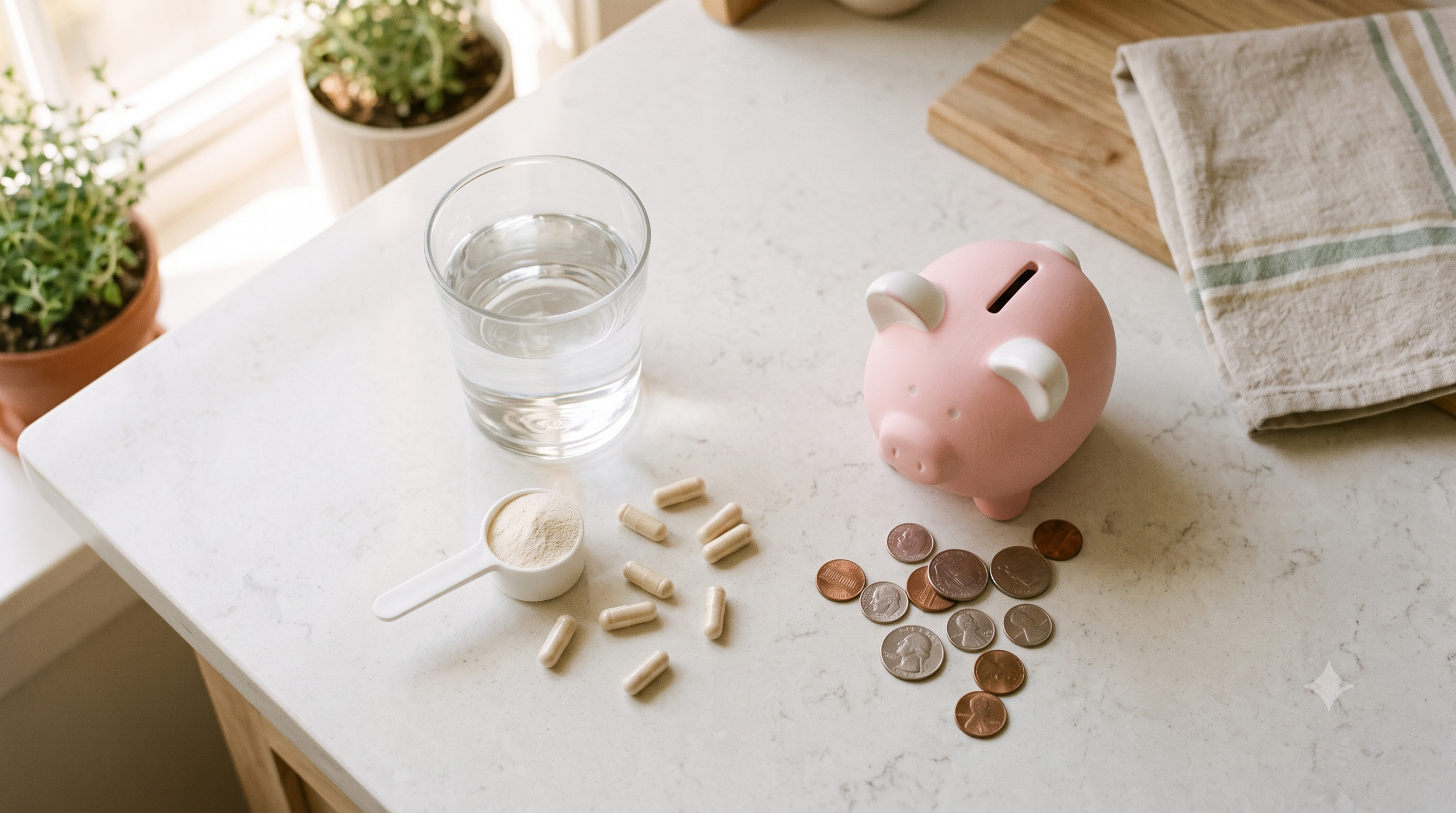
When it comes to supplements, the market is overwhelming — and expensive. Americans spend over $60 billion a year on dietary supplements, and most people have no idea whether what they are taking is actually backed by science. If you are looking for a supplement that is affordable, extensively researched, and delivers real value per dollar, creatine monohydrate deserves your attention. At roughly a dollar a day — less than your morning coffee — it may be one of the smartest health investments you can make.
Key Takeaways
- Creatine monohydrate is one of the most studied and affordable supplements available, costing roughly a dollar a day for a quality formulation.
- Research suggests creatine may support muscle strength, bone health, and cognitive function — benefits that could help reduce costly healthcare expenses down the road.
- Combination supplements that bundle creatine with omega-3s and vitamin D3 can offer better value than buying each nutrient separately.
- Not all creatine products are worth the price — knowing what to look for helps you avoid overpaying.
Why Creatine Stands Out in a Crowded Supplement Market
Walk into any health store or browse any supplement website and you will find hundreds of products making bold claims. Most of them come with premium price tags and limited scientific support. Creatine is different.
It is one of the most extensively studied dietary supplements in existence, with decades of peer-reviewed research behind it. The Journal of the International Society of Sports Nutrition has published comprehensive reviews confirming its safety and efficacy across multiple health domains. Unlike trendy supplements that surge in popularity and then fade when the evidence does not hold up, creatine’s track record has only gotten stronger over time.
And the cost? A month’s supply of a quality creatine supplement typically runs between $30 and $50 — less than what many people spend on a single dinner out, and a fraction of a single co-pay at a specialist’s office.
The Health Benefits That Save You Money
The real value of creatine is not just what it costs at the shelf. It is what it may save you over time by supporting the areas of health that become most expensive as you age.
Muscle Strength and Fall Prevention
Muscle loss accelerates after age 40, and by age 70, many adults have lost 25 to 30 percent of their muscle mass. This decline — called sarcopenia — leads to weakness, balance problems, and falls. Falls are the leading cause of injury-related emergency visits and hospitalizations in adults over 65, with the average fall-related hospital stay costing upward of $30,000.
A 2025 meta-analysis in the European Review of Aging and Physical Activity found that creatine supplementation combined with exercise training significantly improved strength in older adults. Stronger muscles mean better balance, fewer falls, and potentially thousands saved in medical bills. Even modest improvements in lower-body strength can make the difference between catching yourself on a stair railing and ending up in the emergency room.
Cognitive Function
Mental decline carries its own financial burden. Memory care facilities, cognitive assessments, and the lost ability to manage your own finances all add up. A 2026 systematic review in Nutrition Reviews found that five out of six studies reported a positive relationship between creatine and cognition in older adults, particularly in memory and attention.
While more research is needed, the early evidence suggests that creatine may help keep your mind sharp — which is worth more than any dollar figure when it comes to maintaining your independence and managing your money effectively.
Bone Health
Osteoporosis-related fractures cost the U.S. healthcare system an estimated $19 billion annually. Research suggests creatine may indirectly support bone health by improving the muscle mass and strength that protect against falls and fractures. One study on elderly women showed that short-term creatine supplementation significantly improved performance on functional movement tests like sit-to-stand exercises — the exact type of movements that prevent the falls leading to hip fractures and lengthy rehabilitation.
How to Buy Creatine Without Wasting Money
Not all creatine products are created equal, and the supplement industry is full of unnecessary markups. Here is how to get the most value.
Stick with Creatine Monohydrate
This is the gold standard — the exact form used in the vast majority of clinical studies. You will see companies selling creatine hydrochloride, buffered creatine, creatine ethyl ester, and other variations at two to three times the price. None of them have been shown to outperform basic creatine monohydrate. Do not pay extra for marketing.
Look for “Micronized” on the Label
Micronized creatine monohydrate has been processed into finer particles, which improves how well it dissolves in water and may improve absorption. The price difference is minimal, but the quality improvement is noticeable — no gritty residue at the bottom of your glass.
Skip the Proprietary Blends
Many pre-workout and fitness supplements include creatine as part of a “proprietary blend” with a dozen other ingredients. The problem is you often have no idea how much creatine you are actually getting, and you are paying a premium for fillers, artificial flavors, and stimulants you may not need. A straightforward creatine supplement with clear dosing is almost always the better deal.
Consider a Combination Supplement for Better Per-Nutrient Value
If you are already taking — or considering — omega-3 fatty acids and vitamin D3 alongside creatine, buying them separately means managing three different products, three different price points, and three different expiration dates. That adds up.
Omega-3s support heart and brain health, while vitamin D3 is essential for bone density and immune function — both nutrients that aging adults commonly need more of. Combination supplements that bundle all three can simplify your routine and often cost less per nutrient than buying each one individually. Omegatine, for example, combines micronized creatine monohydrate with omega-3 fatty acids and vitamin D3 in a single daily supplement designed for adults over 40. It is the kind of consolidation that a budget-conscious shopper appreciates: fewer bottles, less waste, and better value per serving.
The Real Cost Comparison: Prevention vs. Treatment
The math here is straightforward when you zoom out. Consider the annual cost of a daily creatine supplement against the potential costs it may help you avoid:
A year of quality creatine supplementation costs roughly $360 to $600 depending on the product and formulation. Compare that to the average costs of conditions associated with age-related muscle and bone decline: a single fall-related emergency room visit averages $3,500 or more, a hip fracture surgery and rehabilitation can exceed $30,000, and long-term assisted living care averages over $50,000 per year.
No supplement is a guarantee against these outcomes. But when the research supports even modest reductions in risk for roughly a dollar a day, the value proposition speaks for itself. Spending less on a daily supplement than you would on a coffee is one of the more asymmetric bets you can make on your health.
How to Take Creatine Effectively
Getting the most from creatine does not require a complicated routine.
Dose. Three to five grams per day of creatine monohydrate is the standard, research-backed recommendation. Some people start with a loading phase of 20 grams per day for five to seven days, but simply taking the maintenance dose daily works just as well — it just takes a couple of weeks longer to reach full muscle saturation.
Timing. There is no magic window. Take it whenever works best for your schedule — with breakfast, after a walk, or mixed into a smoothie. Consistency matters more than timing.
Pairing with exercise. Creatine produces its strongest benefits when combined with physical activity, particularly resistance training. You do not need a gym — bodyweight exercises, resistance bands, or even a daily walk can make a meaningful difference. The point is to give your muscles a reason to use the extra energy creatine provides.
Safety. Creatine monohydrate is one of the most studied and well-tolerated supplements available. A 2025 safety review in the Journal of the International Society of Sports Nutrition confirmed that reported side effects are rare and typically mild at recommended doses. As always, check with your healthcare provider before adding any supplement to your routine.
What to Look for When Shopping
Here is a quick checklist for evaluating any creatine supplement before you buy:
Third-party testing. Look for products that have been independently tested for purity. This ensures what is on the label is actually in the container.
Clean ingredient list. The shorter the better. You want creatine monohydrate without a long list of artificial additives, fillers, or unnecessary extras.
Designed for your life stage. Many creatine products are marketed toward young gym-goers and loaded with caffeine or pre-workout stimulants. If you are over 40, look for formulations designed with your needs in mind. Products like Omegatine skip the gym-bro marketing and focus on what actually matters for long-term health — clean creatine paired with the nutrients aging adults benefit from most.
Price per serving. Always calculate the cost per serving, not just the sticker price. A $39 product that delivers a full 30-day supply with multiple nutrients is a better deal than a $25 single-ingredient product that only lasts 20 days. This is personal finance 101 applied to your supplement shelf.
Frequently Asked Questions
Is creatine only for bodybuilders and athletes? Not at all. While creatine gained popularity in sports, the majority of recent research focuses on its benefits for general health, aging, and cognitive function. It is relevant for anyone interested in maintaining strength and mental sharpness — especially after 40.
Will creatine make me gain weight? Creatine may cause a small increase in water weight within the muscles during the first week or two, typically one to three pounds. This is not fat — it reflects better hydration within muscle cells, which supports their function. It stabilizes quickly.
Is it safe to take creatine long term? Yes. Long-term studies have consistently shown that creatine monohydrate is safe at recommended doses of three to five grams per day. Talk to your doctor if you have pre-existing kidney conditions.
Is it cheaper to buy creatine separately or in a combination supplement? It depends on your routine. If you are already taking omega-3s and vitamin D3, a combination product like Omegatine often works out cheaper per nutrient than purchasing three separate supplements — plus you save time and reduce the chance of missing a dose.
How long does it take to notice results? Most people begin to notice improvements in energy during exercise within two to four weeks of consistent daily use. Cognitive and long-term health benefits build gradually over months.
Bottom Line
Creatine monohydrate is not a miracle pill, and no supplement replaces good nutrition, regular movement, and sound financial planning. But as far as health investments go, it is hard to find a better risk-to-reward ratio. Decades of research, a strong safety profile, and a daily cost comparable to your morning coffee make creatine one of the most sensible line items you can add to your monthly budget. Your future self — and your future wallet — will thank you.
This article is for informational purposes only and does not constitute medical or financial advice. Always consult with a qualified healthcare professional before starting any new supplement regimen.